
Hood & Exhaust Cleaning
Clean from
hood to fan.
Commercial hood cleaning and kitchen exhaust cleaning designed to remove grease throughout the system, maintain NFPA 96 compliance, and give operators clear documentation after every service.

NFPA 96 focused
Before & after documentation
Multi-location support
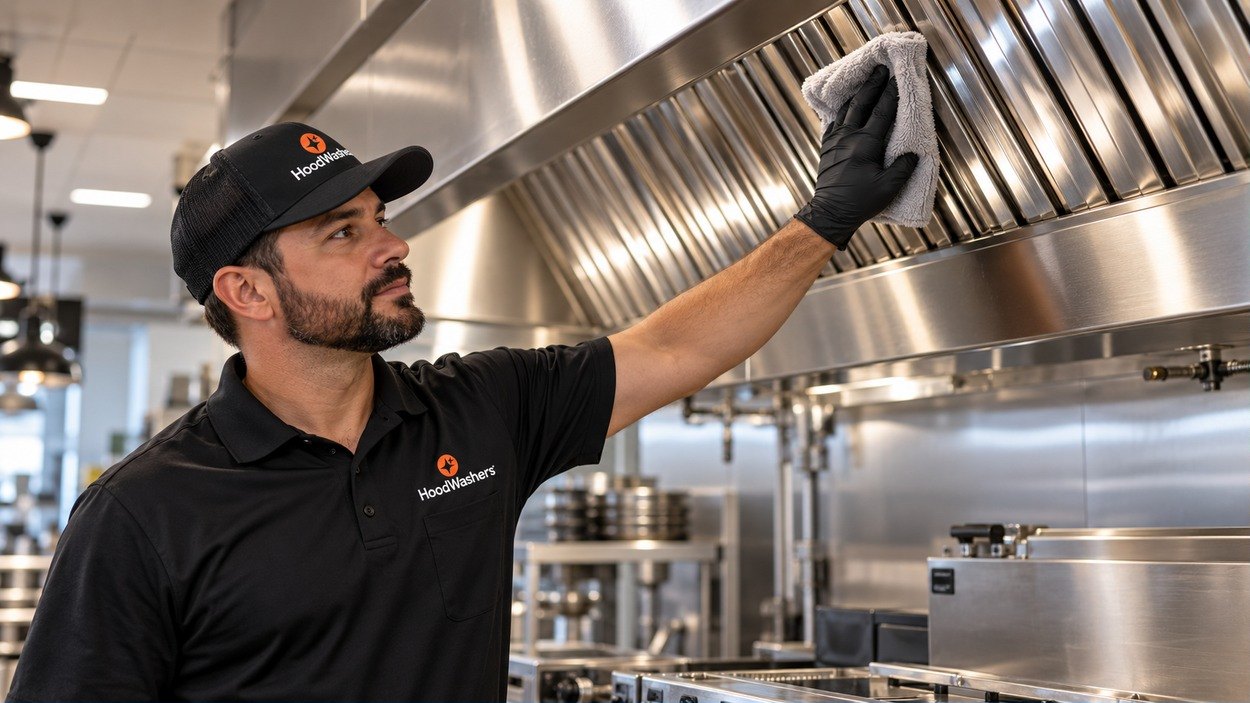
After Service Report
Photos, findings & next service date on every job.
The system
Grease doesn’t stop at the hood.
Cooking vapor carries grease through every part of the exhaust system. A wipe-down of the visible stainless leaves most of it behind, so we service the whole path, hood to fan.
01
Hood
The canopy over the cook line captures heat, smoke, and grease-laden vapor first.
02
Plenum & filters
Behind the filters, grease condenses in the plenum, one of the most commonly missed areas.
03
Ductwork
Grease vapor cools and coats the duct walls as it travels up and out of the building.
04
Exhaust fan
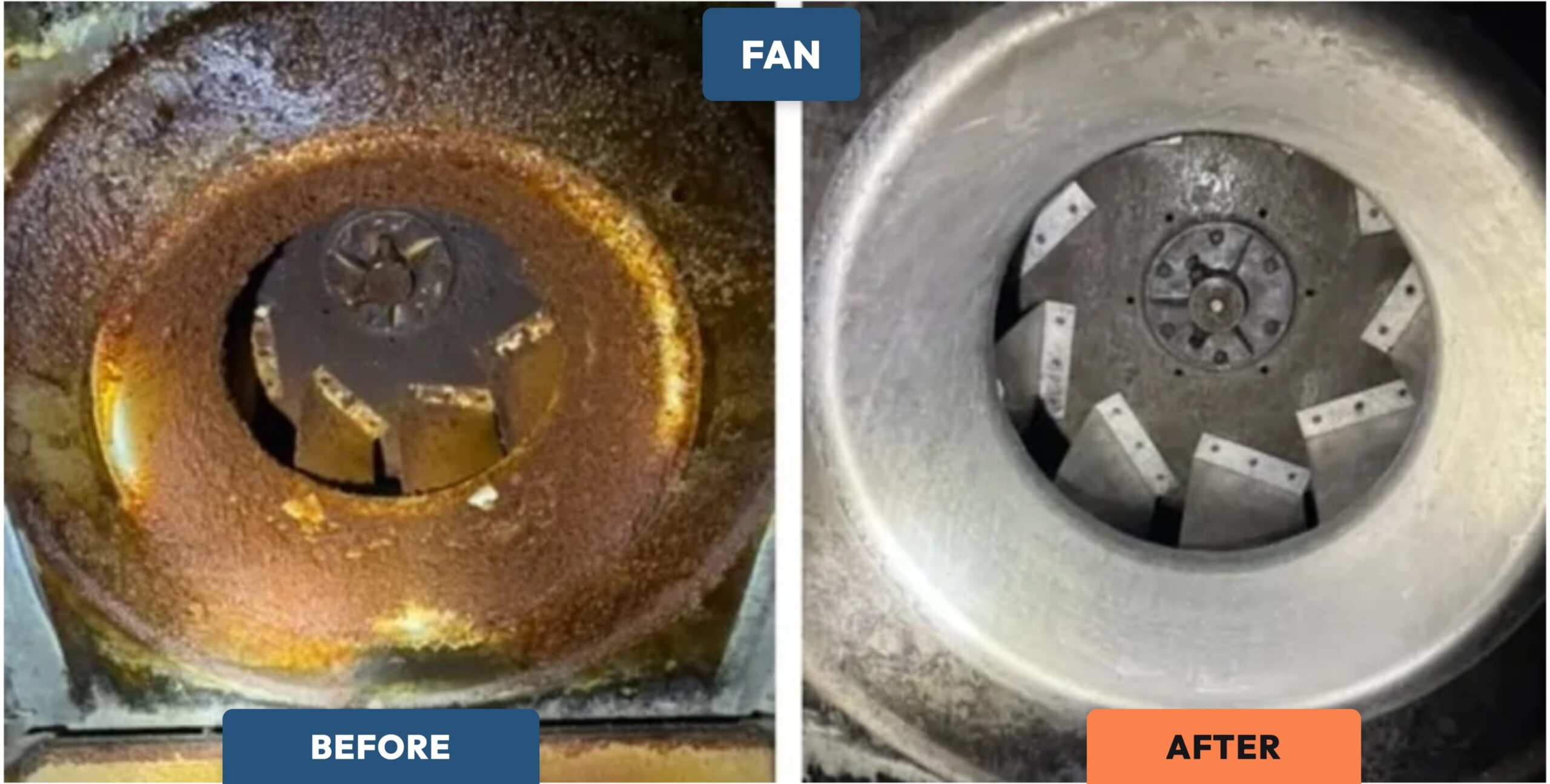
Fan blades and housing collect heavy buildup that affects airflow and performance.
05
Rooftop discharge
What the fan pushes out lands around the curb and roof surface.
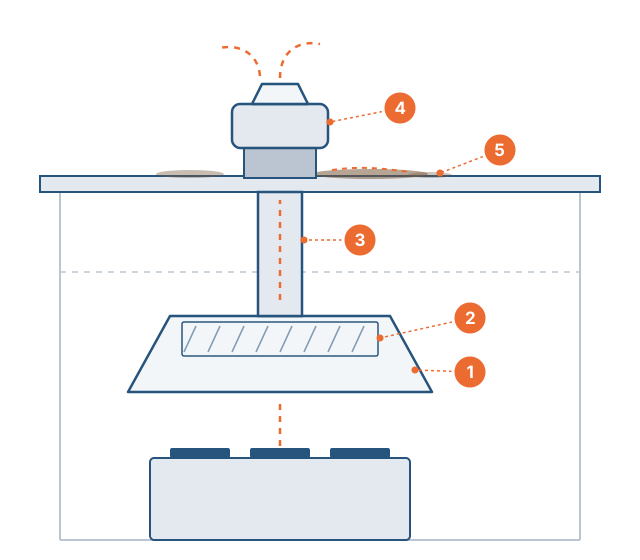
Numbers on the diagram match the system stages.
Not sure what’s built up past the hood?
Behind the scenes
What commercial hood cleaning looks like with HoodWashers.
Most commercial hood cleaning happens after close, out of sight. Here’s what our crews actually do on site.

01 · Setup
Protect the kitchen first
We cover cook lines and equipment, set up containment, and isolate the work area before any cleaning starts.
02 · Scrape & degrease
Break down the buildup
Heavy deposits are scraped by hand, then commercial degreaser is applied throughout the hood, plenum, and accessible duct.
03 · Hot-water wash
Rinse to bare metal
Hot-water pressure washing removes loosened grease from the hood, filters, and ductwork.
04 · Duct & fan
Finish the full path
We clean the accessible ductwork and the exhaust fan on the roof, including the blades, housing, and curb area.
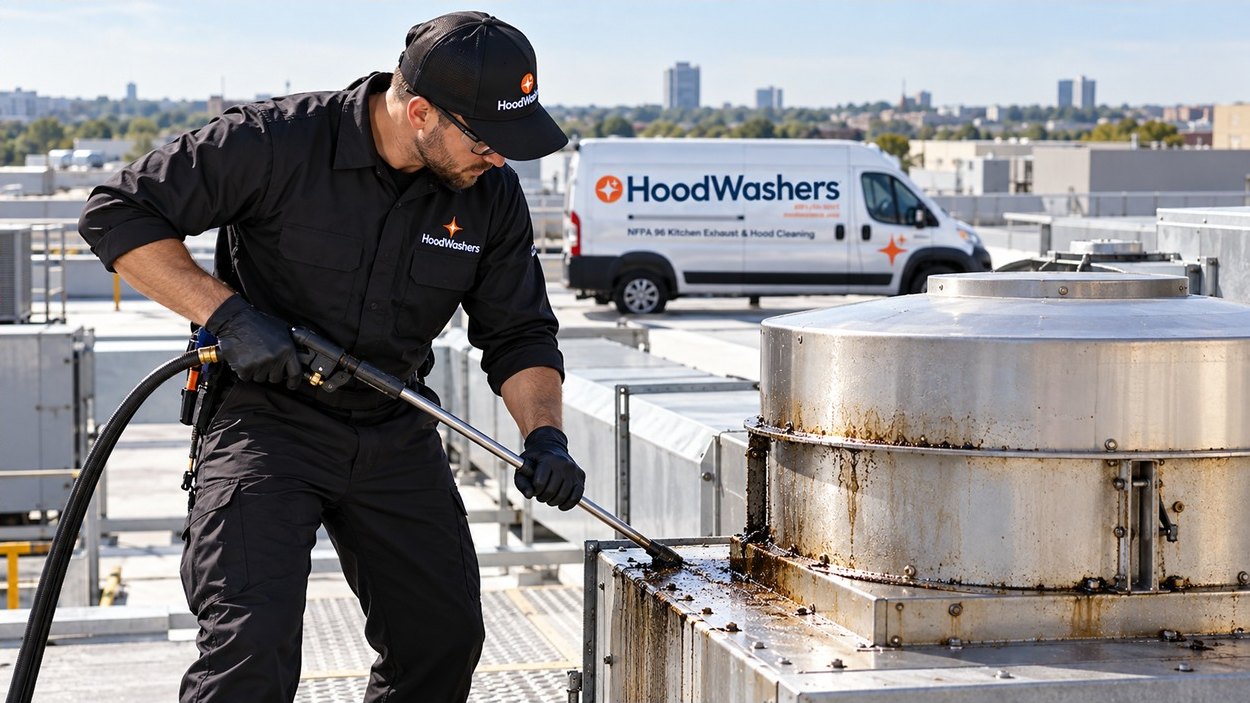
05 · Cleanup
Leave it ready for service
Wastewater is contained, covers come off, and stainless is wiped down so the kitchen is ready to open.
06 · Documentation
Show the work
Before-and-after photos, findings, and the next recommended service date go into your After Service Report.
See what a full-system clean looks like on your hood.
Documentation
Clean is only part of the job.
Every service ends with a report you can use for your records, your restaurant group, your insurance carrier, or the next inspection.

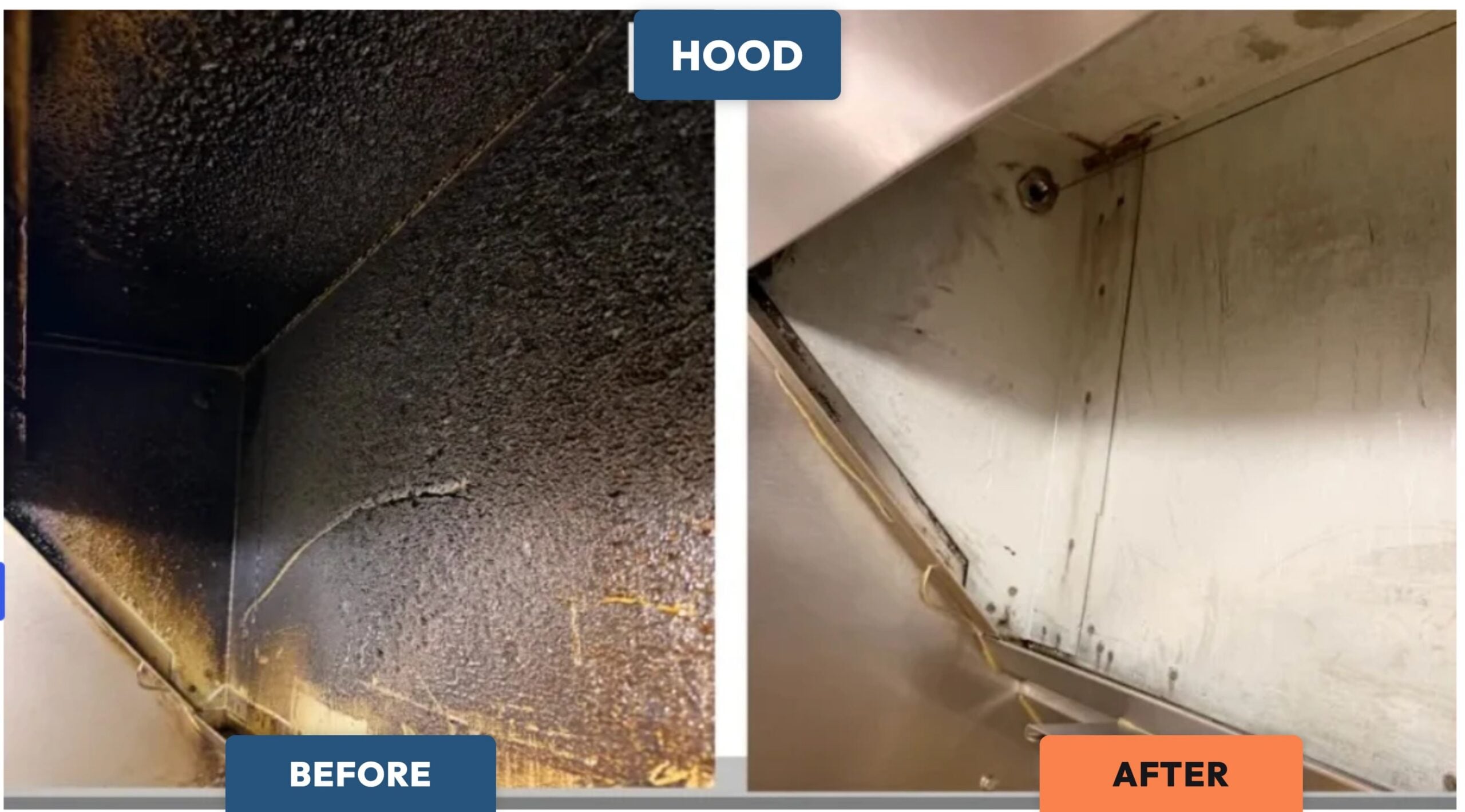
Before & after photos
Of the hood, filters, ductwork, and fan.
Service date & technician
Who did the work and when.
Deficiencies noted
Issues we find are documented, not ignored.
Next service due
A recommended interval based on how your kitchen cooks.
After Service Report
Sample
Service date
[Date of service]
Technician
[Crew lead name]
System
Hood · plenum · duct · fan
Next service due
[Based on cooking volume]
Deficiencies noted
Listed with photos when found, such as damaged filters or missing access panels.
Illustrative sample. Actual reports reflect each service.
Want this documentation for every location?
Why it matters
Why the details matter.
Commercial hood cleaning isn’t about shiny stainless. It’s about what’s left inside the system after the crew leaves.
Fire risk
Grease left in ducts and fans is fuel. Removing it throughout the system lowers the load.
Airflow & performance
Clean fans and ducts move air the way they were designed to, which keeps the line cooler and more comfortable.
Inspection readiness
Documented, recent service makes inspections and insurance conversations straightforward.
Grease accumulation
Buildup grows every shift. A schedule matched to your cooking volume keeps it in check.
Consistency across locations
Every kitchen held to the same standard, with the same report format.
Find out where your system stands.
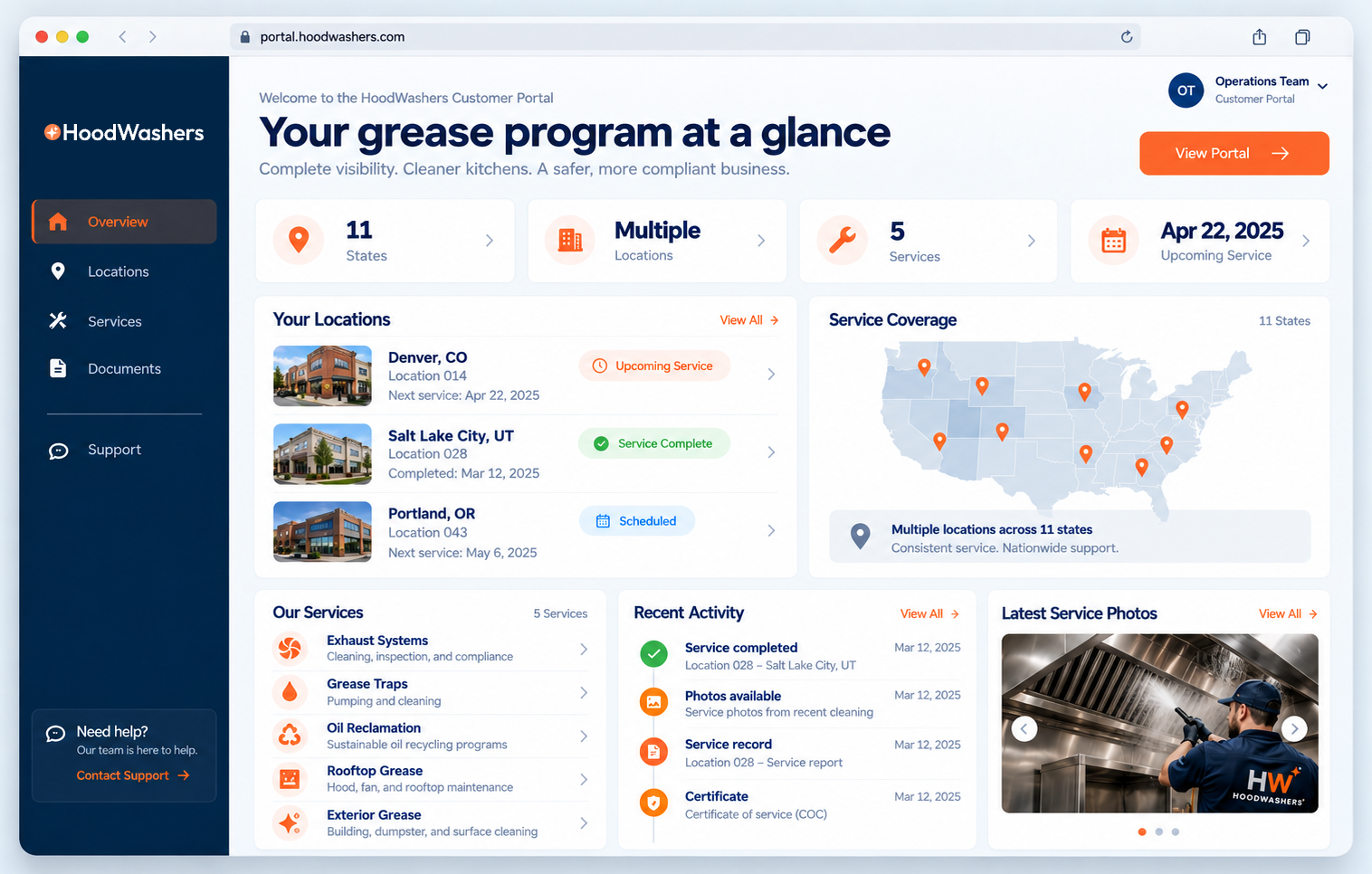
Illustrative portal preview. Data shown is sample data.
For chains, franchises & campuses
One exhaust-cleaning standard across every location.
Restaurant groups, franchise operators, universities, and facilities teams get one coordinated commercial hood cleaning program instead of a different vendor in every market.
Locations
Schedules
Documentation
Completed service
Upcoming service
One point of contact
Proof
Recent work.
Trusted by teams that expect consistency




Ready for a cleaner exhaust system?
Common questions
How often should commercial kitchen hoods be cleaned?
It depends on how the kitchen cooks. NFPA 96 sets inspection frequencies by volume and fuel type: monthly for solid-fuel cooking, quarterly for high-volume operations like 24-hour kitchens, charbroiling, or wok cooking, semiannually for moderate volume, and annually for low-volume kitchens. We recommend a schedule based on what we see in your system and your local authority’s requirements.
What parts of the exhaust system do you clean?
The full path: hood, filters, plenum, accessible ductwork, and the exhaust fan, plus the fan curb area on the roof.
What is NFPA 96?
NFPA 96 is the National Fire Protection Association standard for ventilation control and fire protection of commercial cooking operations. It covers how kitchen exhaust systems are inspected, cleaned, and maintained to reduce fire hazards. Many fire marshals and insurers reference it.
Do you clean ductwork and exhaust fans?
Yes. Ductwork and the exhaust fan are part of every hood and exhaust cleaning service, since that’s where much of the grease ends up.
Do you provide documentation after service?
Yes. You receive an After Service Report with before-and-after photos, service details, any deficiencies we noted, and the next recommended service date.
Can HoodWashers service multiple restaurant locations?
Yes. We coordinate service, scheduling, and documentation for multi-location operators across our service area: UT, CO, OR, WA, ID, CA, NV, AZ, MT, WY, and NM.
Can cleaning be performed overnight?
Yes. Most hood and exhaust cleaning is done overnight, early morning, or on weekends, when your kitchen is closed.
Less Stress. More Trust.
Know what’s inside your exhaust system.
Start with a free inspection. We’ll look at the system, document what we find, and recommend the right service schedule for your kitchen.